
The step-by-step answer to “However much I earn, nothing is left.”
A practical money system that takes you from your monthly salary to your first ₹10 lakh, one rung at a time: a six-line salary-day routine, a 7-rung ladder, 17 worksheets and two Excel workbooks. It teaches you how to decide, not what to buy.
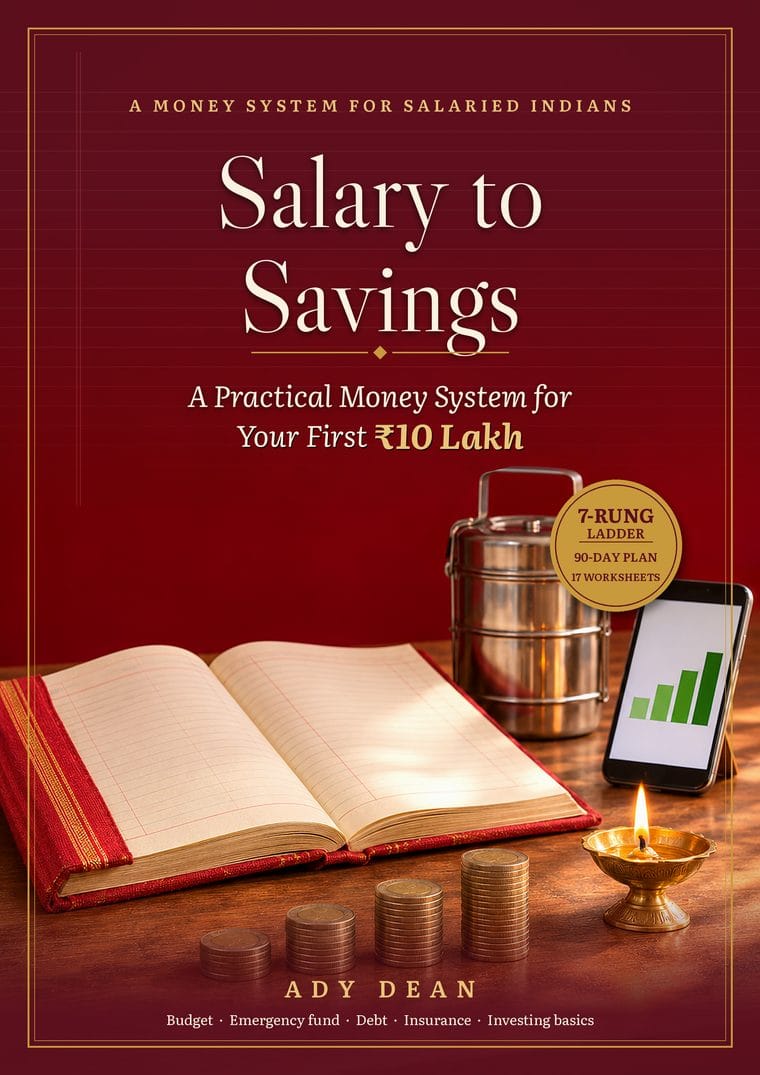
Your salary arrives. A few weeks later it has gone, and you're not sure where.
No one teaches this at school or at work. So most of us run our money on advice from relatives, colleagues and reels, and end up doing one of these:
- Saving “whatever is left” at the end of the month, which usually turns out to be nothing.
- Paying the minimum on a credit card and watching the balance stay stubbornly where it is.
- Starting three SIPs in one excited month, then stopping them all when a wedding or a hospital bill arrives.
- Buying a policy in March to “save tax” without checking whether the deduction even applies to you.
- Being caught out by Diwali, insurance renewals and weddings, as if they weren't coming every year.
Sometimes the salary really is too small, and the book deals with that too. But more often, the problem is that there's no system deciding where each salary goes before the month decides for you.
The Salary-to-Savings Ladder
- 6₹10 lakh corpusMilestone
- 5₹5 lakh corpus
- 4₹3 lakh corpus
- 3Emergency reserve at your target
- 2Expensive debt cleared
- 1Starter buffer: one month of essentials
- 0Stop new expensive borrowingStart
Stop chasing tips. Climb one rung at a time.
₹10 lakh is a long climb, so the book breaks it into seven rungs. Each one makes you safer than the one before, and you always know which one you're on.
- One job at a time. Your salary is split into six lines, and the sixth, your “current priority”, has one job: a buffer, a debt, your reserve, then investing.
- Contributions first, growth second. Every timeline starts with what your own contributions add up to. Any growth rate is labelled as an assumption, not a promise.
- Count what's really yours. Your ₹10 lakh counts your reserve and the long-term money you chose to invest, including PPF, VPF and NPS. Mandatory EPF goes on a separate retirement dashboard, so nothing is counted twice.
Everything you need to run your money from your next salary day
Short chapters
In six parts, from reading your payslip to tax, insurance, raises and big life decisions.
Worksheets
Each with a filled example and a blank to complete, from your starting point to a one-page money policy.
Excel workbooks
One with the book's worked examples, one blank for your own numbers. 14 tabs, formulas already built.
Day plan
Week by week, with Day 30, 60 and 90 reviews, so the system is running by the end of the quarter.
Payslip and CTC decoder
See why your CTC isn't your take-home, and what PF, gratuity and the labour codes mean for you.
Card and loan payoff plan
List every debt, pick an order, and see month by month when each one clears and what it costs.
Annual-bills calendar
Fund Diwali, weddings and renewals a little each month, so they stop landing on your card.
Reserve and insurance check
Work out your emergency reserve, and find the gaps in employer health and life cover before you need them.
Regime comparison, made simple
The inputs you need to compare the old and new regimes for Tax Year 2026-27, in one dated appendix.
Fraud-proofing and records
Spot “safe account” and fake-adviser scams, and leave records your family can actually use.
See the real pages before you buy
Tap any page to see it full size.
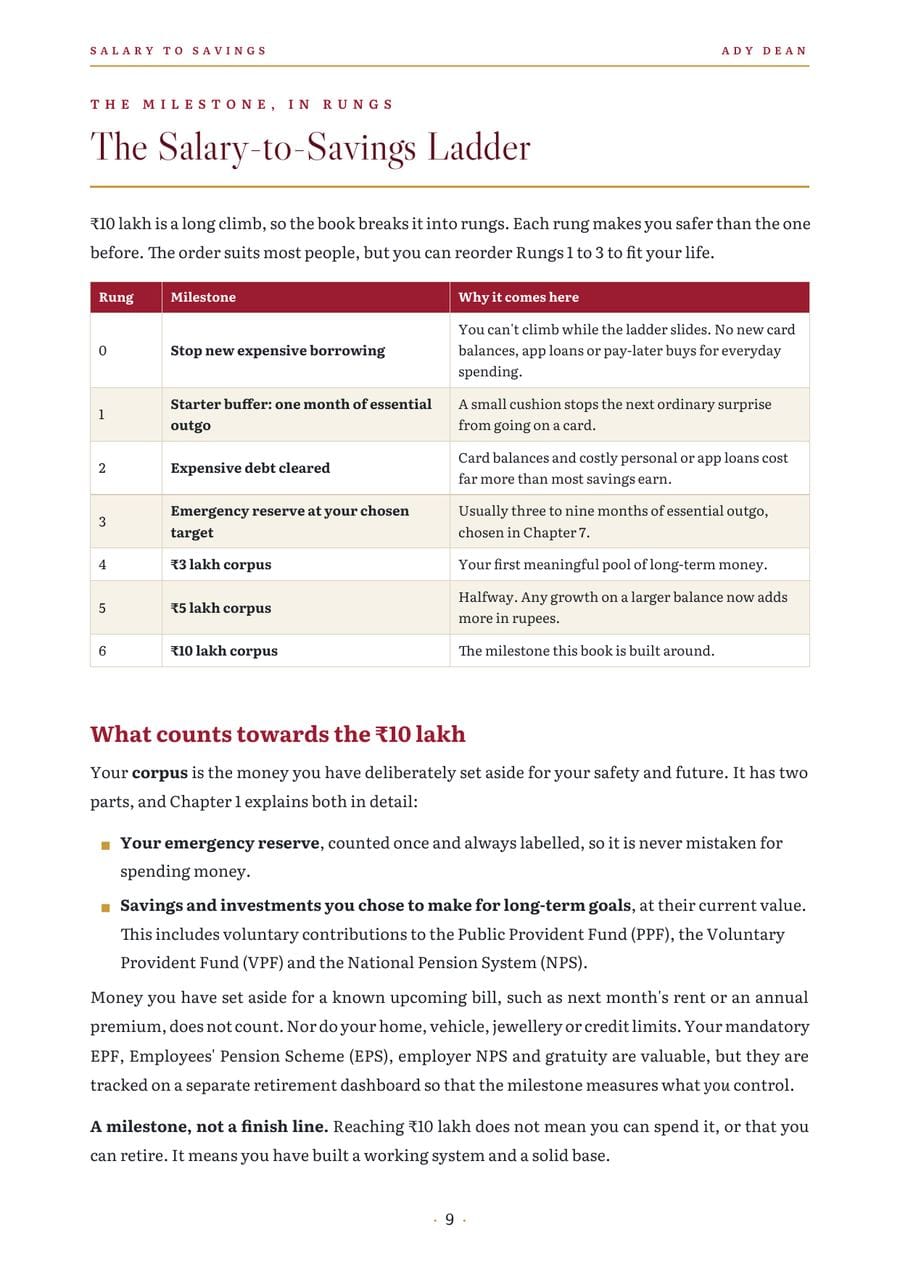 The Salary-to-Savings LadderSeven rungs, in the order most people should climb them.
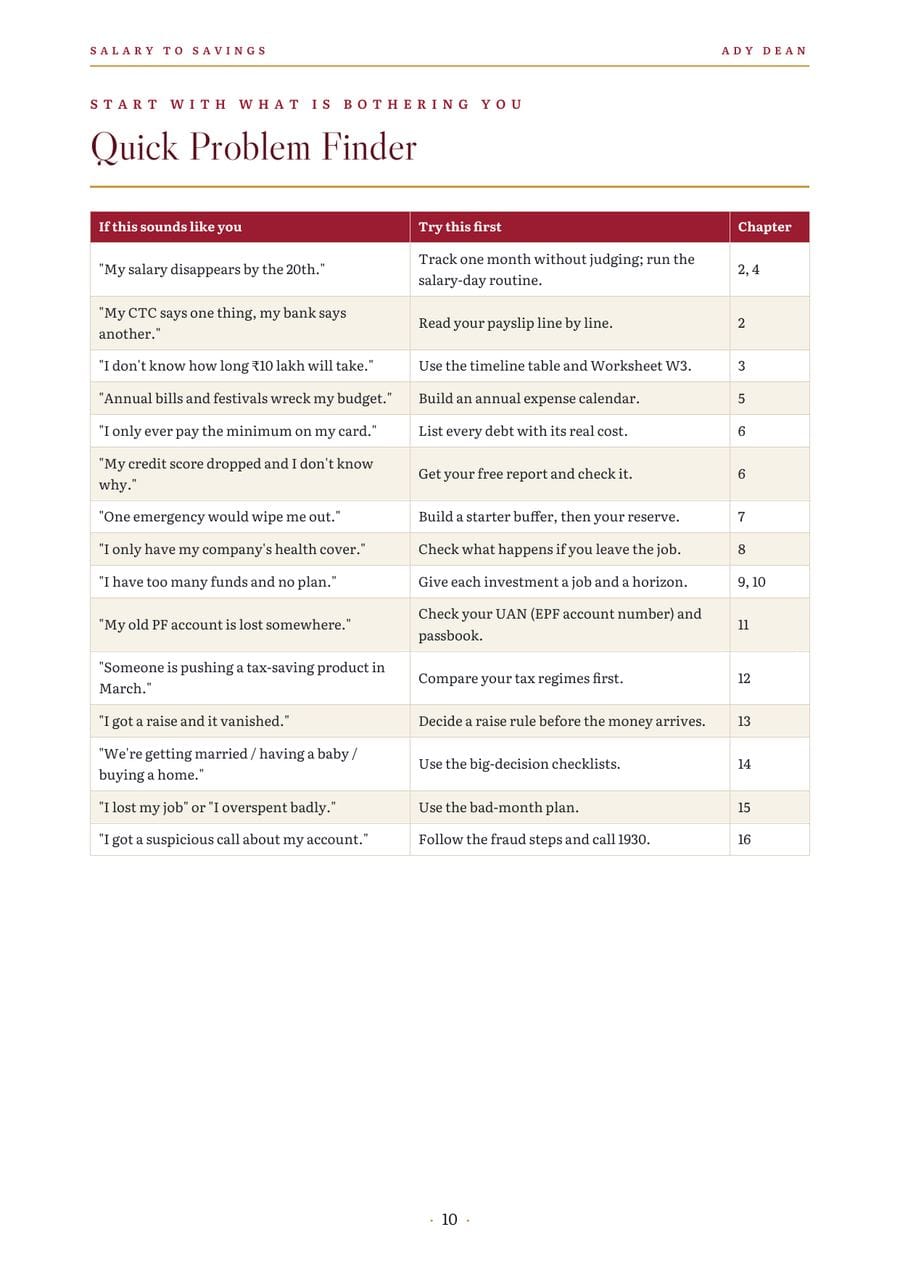 Quick Problem FinderStart from the problem you have today.
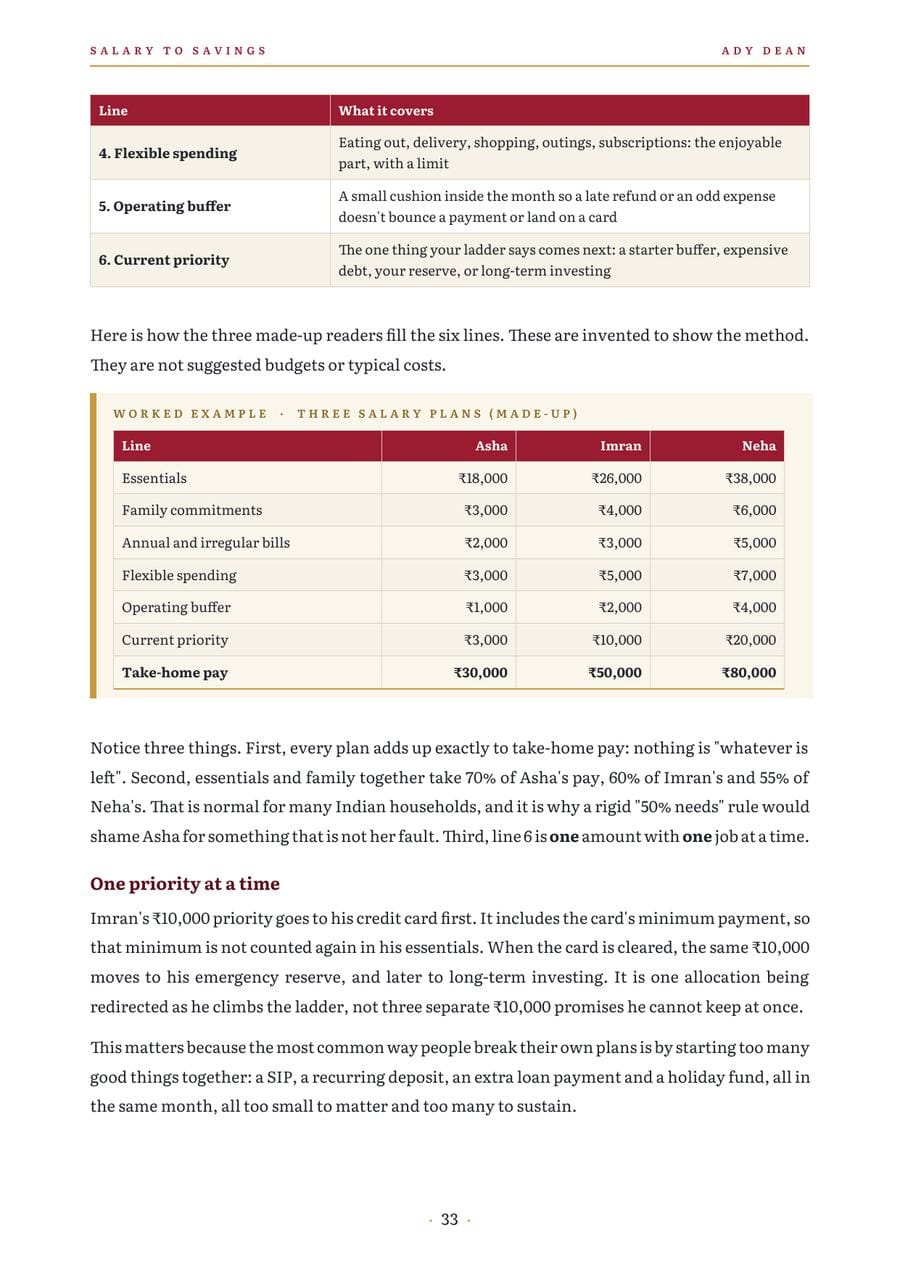 Three salary plansSix salary lines for take-home pay of ₹30k, ₹50k and ₹80k.
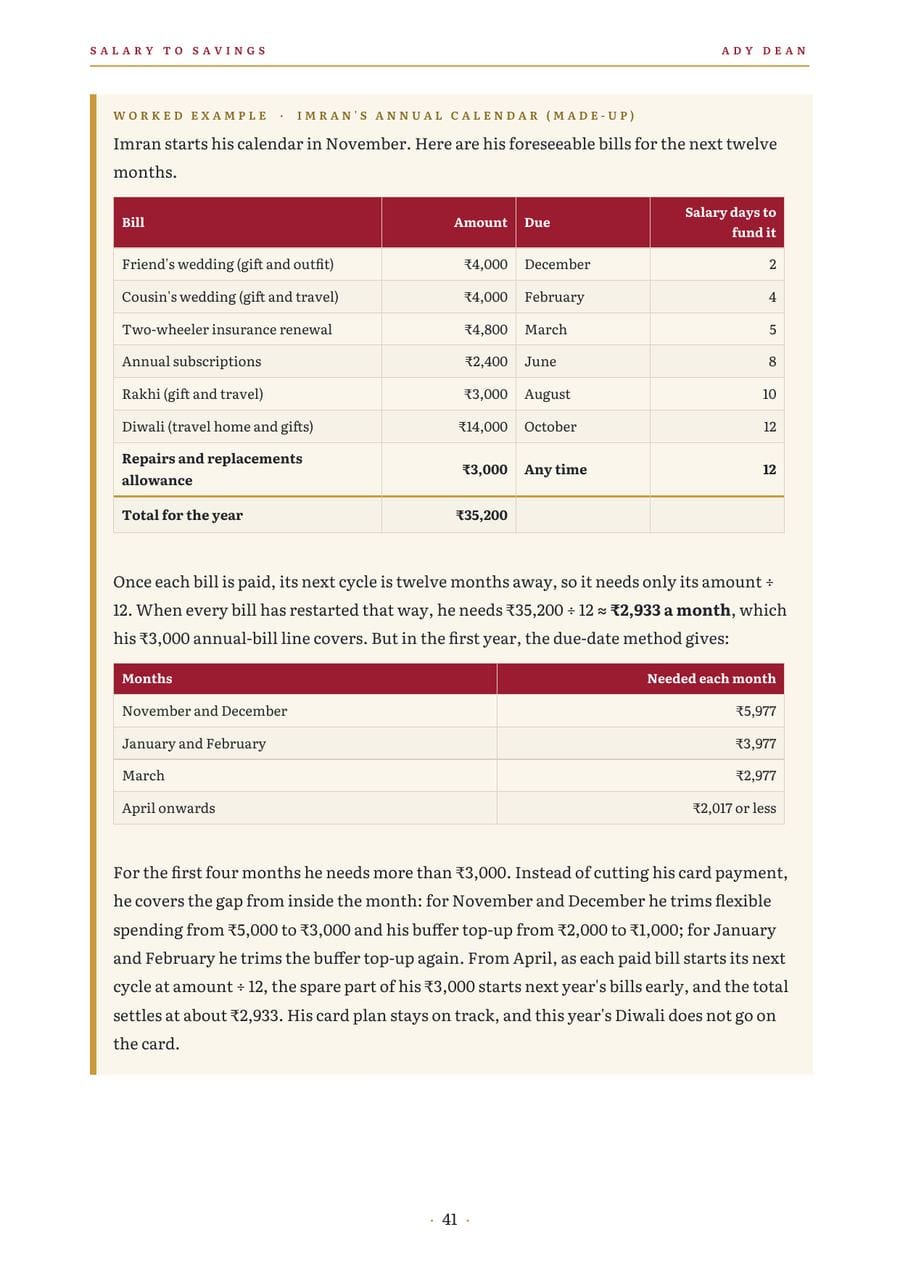 Annual-bills calendarDiwali, weddings and premiums funded before they're due.
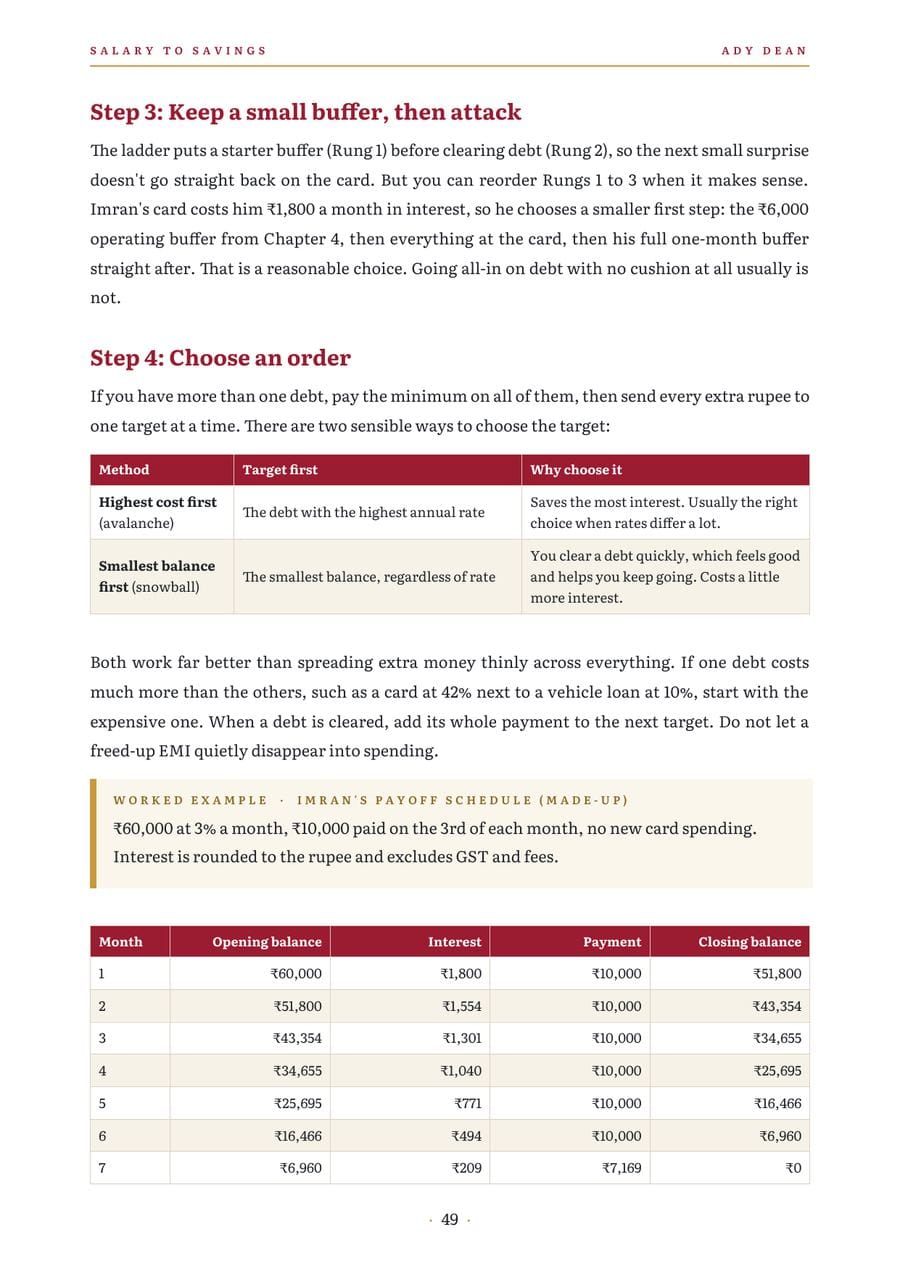 Debt payoff, month by monthA ₹60,000 card balance, cleared in 7 months.
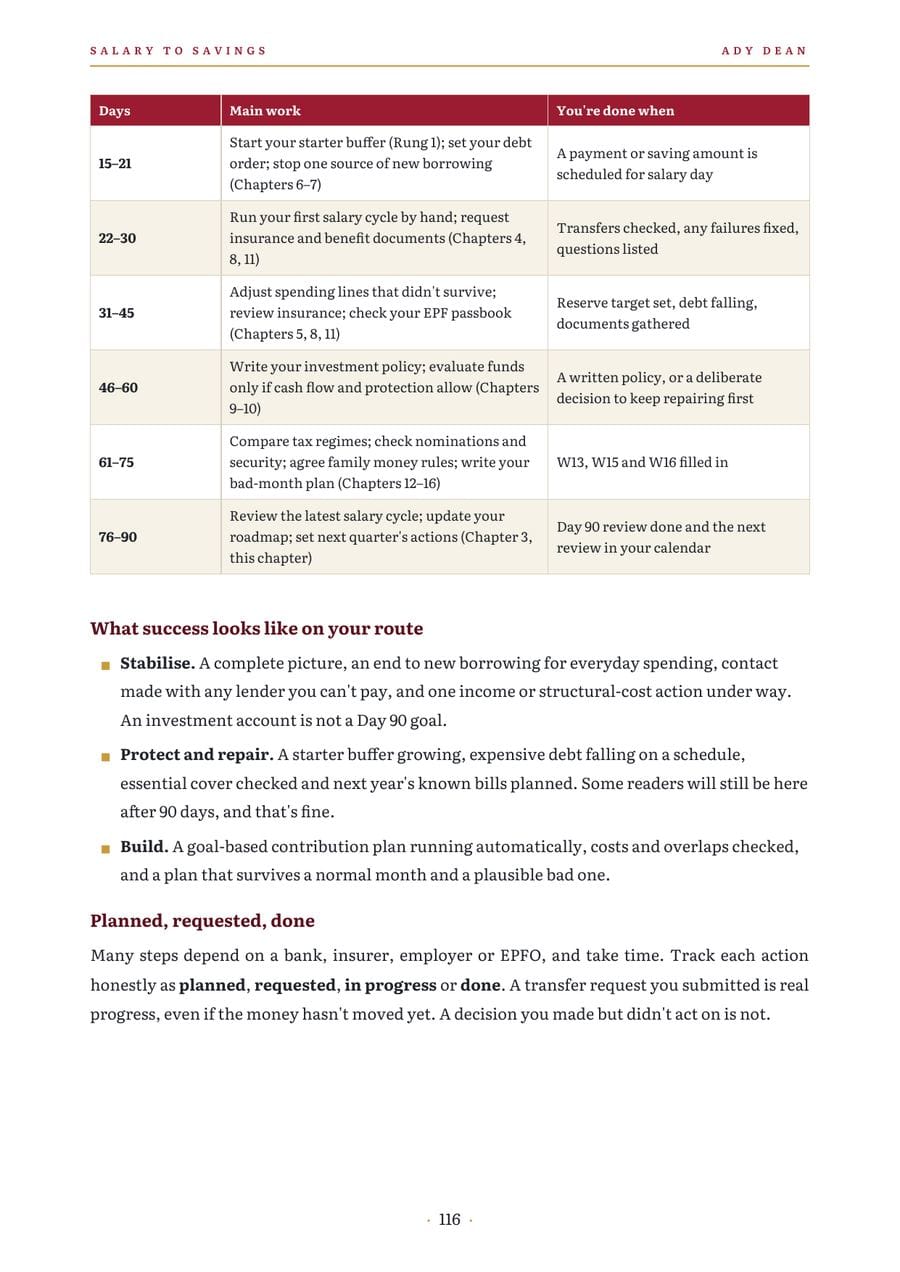 Your 90-day planWhat to do each week, and how you'll know it's done.
Every example shows the working, not just the answer
- Real rupee amounts with Indian digit grouping, for take-home pay from ₹30,000 to ₹80,000 a month
- Month-by-month tables you can check with a calculator
- Growth rates labelled as assumptions, never presented as a forecast or a promise
- A blank worksheet straight after, for your own numbers
- The same example rebuilt in the Excel workbook, so you can swap in your figures
Imran's card, by the numbers
Example from Chapter 6 (Imran is made up)
Built for how salaried Indians actually live
The book starts from where you are. Three made-up readers show the three routes.
First job, nothing left
Like Asha: ₹30,000 take-home, money sent home every month, and the account empty before salary day. You start with a starter buffer and the six salary lines.
A card that won't shrink
Like Imran: a decent salary, but a ₹60,000 card balance and festival months that undo every plan. You clear the expensive debt without ending up back on the card.
Saving, but no plan
Like Neha: some savings, five funds (three of them overlapping) and a parent to support. You set a proper reserve, then give every investment a job.
This book is not for you if…
- you want stock tips, “the best SIP” or a fund to buy. The book names none, on purpose.
- you want trading, futures and options, crypto or borrowing to invest. They're not part of this route.
- you want a guaranteed date for reaching ₹10 lakh. No honest book can promise one.
- your situation involves business income, NRI status or large stock awards. The principles help, but you'll need a professional.
Ninety days to a system that runs itself
Not ninety days to ₹10 lakh. Ninety days to a routine that keeps working long after you've finished the book.
See it
Gather statements, rebuild one real month, choose your route, list next year's bills and set your six salary lines.
Run it
Start your buffer, set a debt order, run one salary cycle by hand, then set your reserve target and check your insurance and EPF.
Grow it
Write your investment policy, check the funds you hold, gather tax inputs and plan for a bad month.
Review it
Update your roadmap, write a one-page money policy and choose next quarter's three actions.
Researched line by line. Not churned out.
A lot of money content online is a stock tip with a thumbnail. This isn't. Every rule can be traced to an official source, and every example is worked out in full.
Every rule has a dated source
RBI, SEBI, IRDAI, EPFO and the Income Tax Department, cited in notes at the end of each chapter. Information checked as of 21 November 2026.
Every number is worked out
Each worked example was recalculated, and the Excel workbook reproduces the book's figures, so you can check them yourself.
Education, not a sales pitch
No funds, shares, policies or lenders are recommended, and there are no affiliate links. The book teaches how to choose, then gets out of the way.
Dated, so you know it's current
Tax rates and limits are kept together in one dated appendix, with an official complaints directory for banks, insurers, funds and EPF.

Ady Dean
Ady Dean has worked in technology and product management for more than sixteen years. He leads teams of around thirty people, most of them in the early years of their careers, and builds software products of his own in his spare time. He holds a degree in computer science and an MBA in project management.
Ady is not a financial adviser, and this book doesn't pretend otherwise. What he brings is a system builder's habit of turning a messy problem into clear steps, and many years of watching capable, hardworking people struggle with money because no one had shown them a simple way to run it.
Less than one evening out with friends
One-time payment · instant download · nothing is shipped
Yes, send me the book →Secure checkout by Razorpay · PDF link sent by email · workbook link inside the book
PROMISE
If your PDF doesn't arrive or won't open, email adydean@ebookhut.com. We'll fix it fast, or refund you in full. Details in our refund policy.
Questions, answered
Is this a printed book?
No. It's a PDF ebook you download straight after payment. It works on phone, tablet and computer, and you can print the worksheets for your own household's use.
Will it tell me which mutual fund or stock to buy?
No. It names no fund, share, policy or lender. It teaches you how to give every investment a job, compare options by cost and risk, and check an adviser's registration if you want personal advice.
I earn ₹25,000 a month. Is it for me?
Yes. The Stabilise route is written for exactly this: a starter buffer and a salary plan come before any investing. The worked examples start at ₹30,000 take-home, and the method works at any salary.
I already have a credit card balance or loans. Where do I start?
Start Here (page 8) takes 30 minutes and puts you on a route. If you're in debt, the book sends you to the salary-day routine and the debt chapter first.
How do I get the Excel workbooks?
The book has a link to a Google Drive folder with both workbooks: one filled with the book's examples and one blank for your own figures. They open in Excel or Google Sheets.
How up to date is it?
Rules, limits and Tax Year 2026-27 figures were checked against official sources on 21 November 2026 and are dated in the text. Tax figures live in one appendix, so they're easy to update.
How do I get my copy, and what if something goes wrong?
You'll see a download button straight after payment, and we email you a copy. If the file doesn't arrive, won't open, or you were charged twice, we'll fix it or refund you in full. Write to adydean@ebookhut.com.
P.S. You don't need a bigger salary to start. You need a system that decides where the next one goes before the month does. And when the salary itself is the real limit, the book shows you how to grow it. Start Here takes thirty minutes.
© 2026 EBOOKHUT.COM · Noida, Uttar Pradesh · adydean@ebookhut.com